
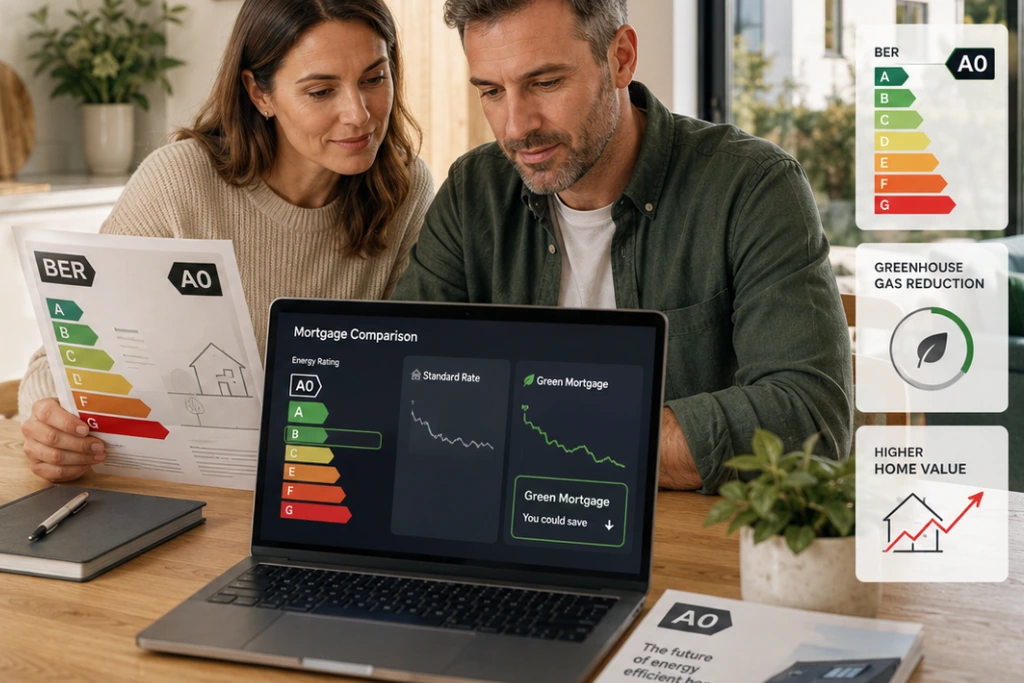
If you are buying, selling, or simply own a home in Ireland, there is an important change happening this month that affects how your property’s energy efficiency is measured and displayed. From 24 May 2026, the Building Energy Rating (BER) system is getting a significant overhaul — and with green mortgage savings of up to €15,000 to €30,000 over the lifetime of a loan now on the table, understanding your BER has never been more financially important.
A Building Energy Rating is essentially an energy efficiency label for your home. Just like the coloured sticker on a washing machine or fridge tells you how much energy it uses, a BER certificate tells potential buyers, tenants, and lenders how energy-efficient your property is.
Every home sold or rented in Ireland is legally required to have a valid BER certificate. The rating is calculated by a registered SEAI assessor who reviews your home’s insulation, heating system, windows, ventilation, and any renewable energy features. The result is a single letter grade, from A (most efficient) to G (least efficient).
In recent years, BER has moved from being a box-ticking exercise to something with real financial consequences. It now directly affects your mortgage rate, your eligibility for SEAI retrofit grants, your property’s market value, and increasingly, your home insurance premiums. In 2026, your BER is one of the most financially significant documents attached to your home.
Up until now, the BER scale has used 15 subcategories: A1, A2, A3, B1, B2, B3, C1, C2, C3, D1, D2, E1, E2, F, and G. From 24 May 2026, this is being simplified in line with a new EU Energy Performance of Buildings Directive (EPBD), which aims to create a standardised approach to energy ratings across all EU member states.
The new scale runs from A to G, with all subcategories removed. There will also be a brand new ‘A0’ category introduced for zero-emission homes — properties that use no fossil fuels on-site and meet a very high standard of energy performance. This paves the way for the next generation of near-zero energy buildings that will become the norm for new builds from 2030 onwards.
The new BER certificate will also contain additional information beyond just the energy rating, including metrics on greenhouse gas emissions, renewable energy usage, and specific recommendations for improving the property’s energy performance and reducing its carbon footprint.
This is the question most homeowners are asking, and the answer is reassuring for the vast majority. All existing BER certificates remain valid for 10 years from their date of issue. The change only takes effect when a new certificate is issued after 24 May 2026. So if your home already has a valid BER cert, you do not need to do anything immediately.
However, if you are in the process of selling or renting your property and need to commission a new BER assessment after 24 May, you will receive the new simplified certificate. And if you are a buyer reviewing a property’s energy credentials, it is worth understanding that older certs use the 15-point scale while newer ones will use the simplified A to G format.
This is where the BER change becomes particularly relevant for anyone with a mortgage or planning to get one. Green mortgages — home loans that offer a reduced interest rate for energy-efficient properties — have become a mainstream product in Ireland, and the savings involved are substantial.
Most Irish lenders, including AIB, Bank of Ireland, PTSB, EBS, and Haven,, now offer green mortgage products. To qualify, your property typically needs a BER of B3 or better under the current scale. With the new simplified scale, this broadly translates to a B rating or better.
The rate discount available for a green mortgage is typically 0.1% to 0.3% below the standard equivalent rate. That might not sound dramatic, but on a €300,000 mortgage over 30 years, a 0.2% reduction saves approximately €10,000 to €12,000 in total interest. Bank of Ireland’s EcoSaver product goes a step further, offering a discount at every BER grade, with larger discounts for higher-rated homes.
The lowest green mortgage rate currently available on the Irish market starts from 3.00%, making it one of the most competitive products available to any buyer or switcher whose property meets the energy efficiency threshold.
Yes, and many homeowners are doing exactly this. Improving your BER rating not only qualifies you for a lower mortgage rate but also reduces your energy bills, increases your property’s resale value, and makes it more attractive to future buyers. It is one of the few home improvements that pays you back in multiple ways simultaneously.
The SEAI offers a range of grants to help fund energy upgrade works, including:
For those undertaking more substantial works, government-backed Home Energy Upgrade Loans are available from 2.99% through the SBCI scheme, offered by AIB and PTSB. These can be combined with SEAI grants to significantly reduce the upfront cost of a retrofit.
A common and financially rewarding sequence is: commission a BER assessment, identify the upgrades needed to reach a B rating, use SEAI grants to fund the works, then apply for a green mortgage at the improved rate. The savings on your mortgage repayments can exceed the cost of the upgrade works within a few years.
If you are currently in the market to buy or are thinking about switching your mortgage, here are the key steps to take in light of the BER changes:
The BER simplification coming this month is more than a bureaucratic change. It is happening at exactly the moment when energy efficiency has become one of the most financially impactful features of any Irish home. Understanding where your property sits on the scale — and what it would take to improve it — is genuinely worthwhile in 2026.
Want to know whether your home qualifies for a green mortgage rate? Contact our team at Mortgage Navigators for a free consultation and we will walk you through your options across every lender on the market.