
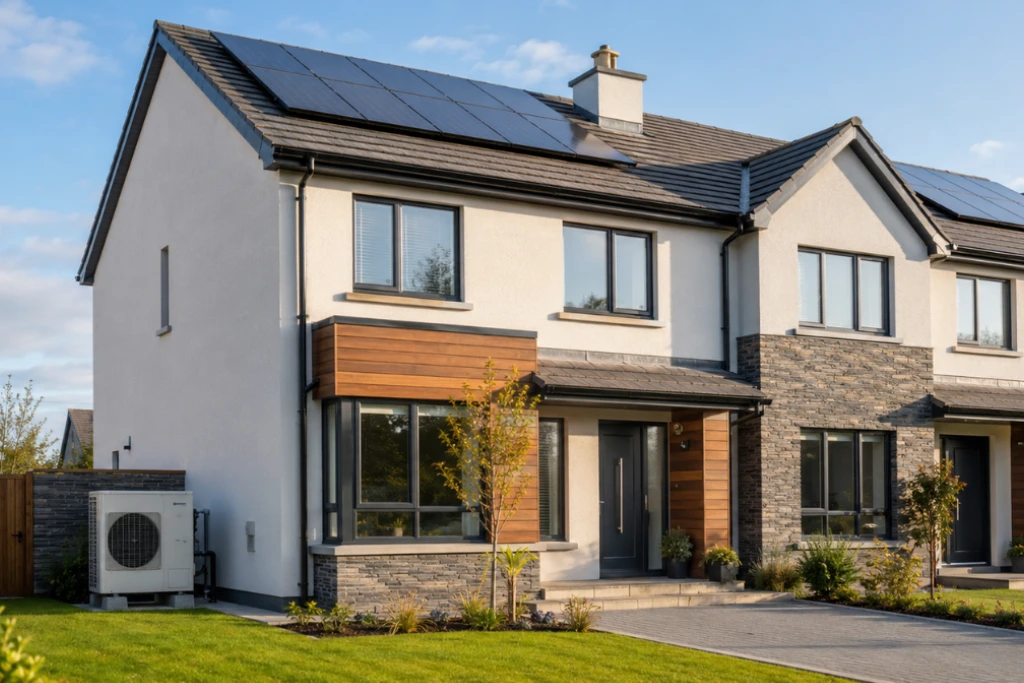
If you’re a homeowner in Ireland weighing up whether to insulate the attic, swap out the old boiler, or finally get that heat pump installed, there’s a financial case for doing it that goes well beyond your energy bills. With grant funding at record levels and green mortgage discounts now standard across every major lender, the right energy upgrades can save you thousands over the life of your mortgage — and in many cases, the upgrade effectively pays for itself.
Most people think about energy upgrades purely in terms of lower heating bills. That’s real, but it’s only half the picture. The bigger, less obvious saving comes from what a better BER does to your mortgage rate.
Every major Irish lender — AIB, Bank of Ireland, PTSB, EBS, Haven and others — now offers a green mortgage with a discounted interest rate for energy-efficient homes. Typically you’ll need a BER of B3 or better (or, under the new simplified scale introduced this year, a straight B or higher) to qualify. The discount itself usually sits between 0.10% and 0.30% off the standard rate, and Bank of Ireland’s EcoSaver product now offers a discount at every BER grade, with bigger savings the higher you climb.
That might sound like a small number but run it over a full mortgage term and it adds up fast. On a €300,000 mortgage over 30 years, even a modest 0.2% rate reduction can save in the region of €10,000 to €16,000 in total interest. Stack that on top of the reduced energy bills from the upgrade itself, and the combined saving over the life of the loan can run well into five figures.
2026 has brought the most generous package of home energy grants the State has ever offered, with government funding targeting tens of thousands of homes nationwide. The current SEAI grants include:
Crucially, these grants stack. You don’t need to do a full retrofit in one go — you can insulate the attic this year, upgrade the windows next year, and add a heat pump after that, claiming a separate grant for each stage. A typical three-bed semi-detached home can realistically qualify for somewhere in the region of €15,000 to €20,000 in combined grant support, depending on which upgrades are chosen.
Even with generous grants, there’s usually a balance left to fund upfront. This is where the government-backed Home Energy Upgrade Loan comes in — available through participating lenders including AIB and PTSB at rates from around 2.99% under the SBCI scheme. Used alongside SEAI grants, it significantly reduces the cash you need to find before work even starts.
Here’s where it gets interesting. Take a homeowner with a mid-rated home who invests in attic insulation, cavity wall insulation, a heat pump, and new windows and doors. Between the grants available for each measure, they could realistically offset a large portion of the total project cost from day one.
Once the works push the property’s BER up to B or better, they requalify for a green mortgage rate — saving thousands more in interest over the remaining term, on top of a noticeably lower energy bill every month. For many homeowners, the mortgage rate saving alone recovers the net cost of the upgrade within a handful of years. Everything after that is pure saving.
Energy upgrades used to be viewed purely as a comfort improvement or an environmental one. In 2026, with grant funding at an all-time high and green mortgage discounts built into every major lender’s product range, they’re one of the more reliable ways to reduce the total cost of owning your home.
Want to know what your home could save by upgrading its energy rating? Contact our team at Mortgage Navigators for a free consultation and we’ll walk you through the grants, the green mortgage options, and the numbers specific to your property.